What is Identity for AI?
Artificial intelligence (AI) is transforming the way organizations operate. As AI systems evolve into autonomous agents capable of performing tasks such as scheduling appointments, answering emails, booking flights, and executing code, they transition from passive tools to active users. This shift demands that AI agents operate with well-defined and verifiable identity.
Identity and access management (IAM) solutions are essential for ensuring the security, governance, and regulatory compliance of AI agents, particularly in sensitive domains like finance and healthcare.
Identity for AI refers to the foundational mechanisms that integrate AI agents into existing security and governance frameworks. These mechanisms enable AI agents to:
-
Authenticate themselves securely.
-
Act with authority, either independently or on behalf of a human.
-
Gain authorization to access sensitive data and perform actions.
-
Have their activity audited for transparency and compliance.
-
Operate within existing IAM ecosystems, leveraging established infrastructure.
IAM’s central role
AI agents capable of performing tasks on behalf of a user or system introduce new IAM challenges. Agents frequently need to access sensitive data and use external tools and services, requiring a high level of trust and security.
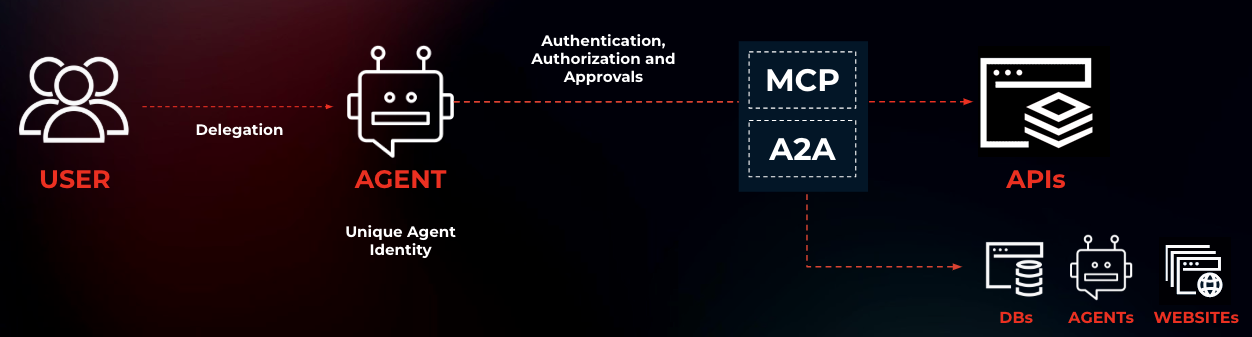
IAM is central to managing agentic AI because:
-
Agents frequently interact with external tools like APIs, web services, and databases. IAM solutions ensure that every request is properly authenticated and authorized.
-
Agents often act on behalf of a human user or another system, requiring a secure method for delegation without sharing human credentials.
-
An agent’s access requirements can change rapidly based on its task, demanding fine-grained, dynamic authorization.
Key benefits
By adapting and extending centralized IAM policies to meet the unique challenges of agentic AI, organizations can achieve several benefits:
- Secure access management
-
Implement robust authentication and authorization mechanisms to protect AI systems and the data they access from unauthorized use and potential breaches.
- Data governance and compliance
-
Ensure that AI agent access and data management activities comply with industry regulations and organizational data policies.
- Auditability and transparency
-
Maintain detailed logs of AI system interactions to support internal auditing and external compliance efforts.
- Scalability and integration
-
Centralize identity management of AI agents to allow seamless integration of new agents with existing IAM solutions.
- Risk mitigation
-
Define, manage, and enforce policies to identify and mitigate risks associated with autonomous AI actions through continuous monitoring and analysis.
Best practices
As AI becomes more integrated into business workflows, it’s crucial to implement IAM best practices to ensure secure and compliant AI systems.
|
Check back often for additional guidance related to best practices as Identity for AI evolves. |
Key principles include:
| Principle | Description |
|---|---|
|
Classify AI agents based on their capabilities, access needs, and risk profiles to tailor your IAM strategies. |
|
Implement mechanisms to identify and authenticate AI agents, ensuring they are who they claim to be before granting access. |
|
Use delegated access with limited scopes instead of sharing human credentials with agents. |
|
Grant agents only the minimum set of access rights and permissions required for their current tasks. |
|
Require explicit human approval for sensitive, high-risk, or irreversible agentic actions. |
|
Log and analyze agent activities to detect anomalies, policy violations, and unauthorized behavior in real time. |


Get started
To get started with Identity for AI:
-
Assess your needs: Evaluate your organization’s AI initiatives and identify security and governance requirements.
-
Train your team: Ensure that your team is knowledgeable about Identity for AI best practices.
-
Implement best practices: Follow Identity for AI best practices for securing your AI systems.
-
Monitor and optimize: Continuously monitor the performance of your AI systems and adjust Identity for AI controls.
|
Contact your Ping Identity representative for more information and help with getting started. |