Unleashing Success: Key Ingredients for PingOne Advanced Identity Cloud
Explore the planning, architecture, integration, testing, and change-management practices that help identity teams succeed with PingOne Advanced Identity Cloud.

This post was originally published on Medium.
Introduction
In today’s digital landscape, organizations face a multitude of challenges when it comes to managing identities and ensuring secure access to their systems. PingOne Advanced Identity Cloud is a powerful solution that enables businesses to streamline their identity and access management (IAM) processes. However, the success of a PingOne Advanced Identity Cloud project depends on several critical factors. In this blog post, we will explore the key ingredients necessary for a successful PingOne Advanced Identity Cloud project.
Roles and responsibility
Understanding the roles and responsibility of the PingOne Advanced Identity Cloud components, external applications, and overall solution will allow an organisation to allocate resources during the project and help maintain the solution moving forward. Knowing where to find the right resources to assist will expedite issue resolution and allow for more efficient solution development.
Platform components
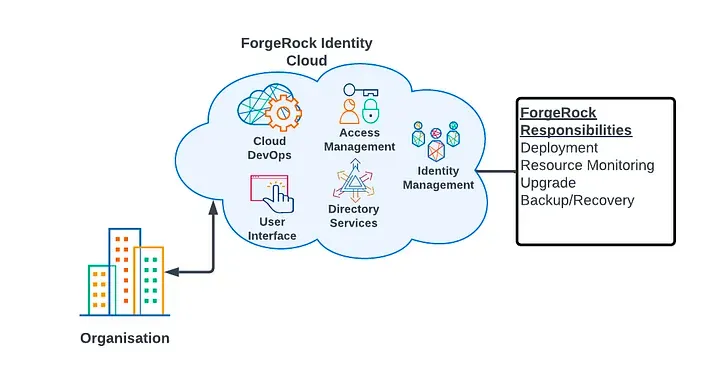
PingOne Advanced Identity Cloud is a SaaS application deployed to Google Cloud Platform. The software components deployed inside the platform are managed by Ping Identity, while external software components that make up the overall solution but do not fit inside the platform are managed by the organisation.
Ping Identity components
Ping Identity is responsible for deploying, managing, upgrading, and monitoring the various software components as part of the platform. Ping Identity also regularly backs up data and provides High Availability and Disaster Recovery. Organisations no longer have to be concerned with spinning up complex architectures for various environments, as Ping Identity does this all for you. Each customer receives a development, staging, and production environment to start, and customers can request any number of sandbox environments to support development; see the environment documentation for more detail.
The following Ping Identity software and services are all wrapped up in a single PingOne Advanced Identity Cloud Platform:
- PingAM
- PingIDM
- PingDS
- Cloud DevOps — Promoting configuration
- Admin UIs / Hosted Pages
Organisation components
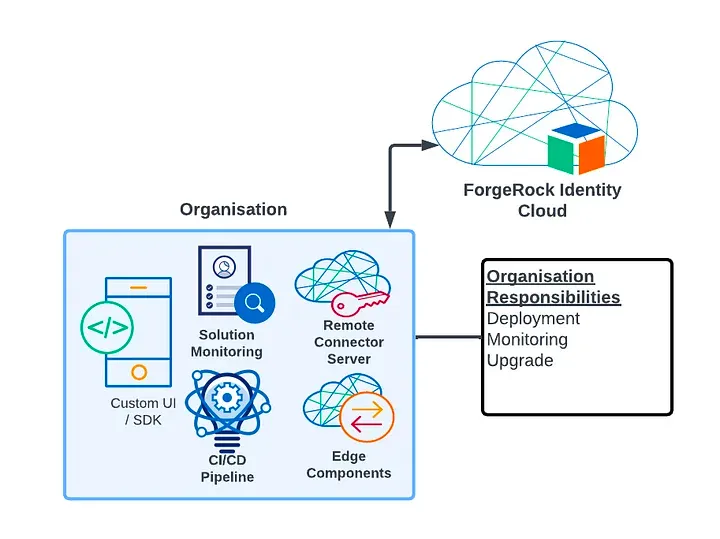
The organisation is responsible for deploying, managing, and upgrading the software and solution components deployed outside of PingOne Advanced Identity Cloud, but still acting as part of the overall solution. Of course, any Ping Identity products deployed onsite will still be covered by Ping Identity product support.
The organisation’s components may include:
- Custom UIs backed by the Ping SDKs
- Remote Connector Servers
- Edge components like PingGateway
- The organisation’s own CI/CD pipeline
- Overall solution monitoring
Customer solution
During the project, a solution will be custom-built by the deployment team to meet the organisation’s requirements. This solution is the product that the organisation owns and is delivering to its customers. Maintenance, monitoring, and enhancements to this product are the responsibility of the organisation. Ping Identity maintains responsibility for the underlying software inside PingOne Advanced Identity Cloud and offers around-the-clock support for any issues that may arise with the software.
For organisations to support the product they are delivering to their customers, some may train or even hire internal technical resources, consult a partner organisation or SI, and may engage Ping Identity technical consultants as required. See Ping Identity technical consulting services for more information.
Technical skills and training
Ping Identity provides comprehensive product training for all of its products; these can be accessed through Ping Identity Training. It is highly recommended that technical resources assigned to the PingOne Advanced Identity Cloud project have attended relevant courses. The courses can help enable resources prior to the project and on an ongoing basis as new technical resources are onboarded. Working with a trusted partner or SI can also help to reinforce the technical skills required. Ping Identity technical consultants will work alongside your teams and assist with the implementation.
Clear objectives and requirements
The foundation of any successful project lies in clearly defining its objectives and requirements. Start by identifying the pain points within your organisation’s current identity management infrastructure and determine the specific goals you aim to achieve with the PingOne Advanced Identity Cloud. These objectives could include enhancing user experience, strengthening security measures, or streamlining administrative tasks.
When moving your solution from an on-premise or legacy system to PingOne Advanced Identity Cloud, we recommend you “Reimagine” your solution using this opportunity to retire technical debt. What are the outcomes that need to be achieved, how will successful achievement of those outcomes be measured, and how will those outcomes benefit your organisation and its customers? Building this into a well-defined roadmap allows alignment between the project team and stakeholders around a shared vision. It is critical that this vision is defined before the project commences, coupled with a clearly defined MVP and key outcome milestones with measurable success criteria.
If you can’t define success, you can’t succeed.
Comprehensive planning and strategy
Once the project objectives are established, it’s essential to develop a comprehensive plan and strategy. Consider factors such as the scope of the project, the resources required, the timeline, and the potential risks involved. Collaborate closely with key stakeholders, including IT teams, security experts, and business leaders, to ensure that the project aligns with broader organisational goals and addresses specific user needs effectively. A project manager for the organisation sitting as part of the project team, and with clear boundaries and scope, will ensure the project focuses on its MVP while meeting its broader long-term goals.
Robust architecture and design
The architecture and design of your PingOne Advanced Identity Cloud deployment are critical for its success. Work closely with experienced architects and developers to design a scalable, flexible, and secure solution that can accommodate your organisation’s current and future requirements. Consider factors such as user volumes, integration capabilities, compliance regulations, and the need for customisation. A well-thought-out architecture will help optimise performance, minimise downtime, and support future expansion. Ping Identity technical consultants will work with the organisation to ensure the solution architecture developed is sufficient for your needs and meets best practices, and can then be incorporated into the organisation’s overall design.
Seamless integration and data migration
A successful implementation of PingOne Advanced Identity Cloud relies on seamless integration with your existing systems. Ensure that your project team has a deep understanding of your organisation’s technology landscape to establish smooth integration points. A careful approach to data migration is also vital to ensure a seamless transition from legacy systems to the new solution. Data cleansing, mapping, and validation processes should be executed meticulously to maintain data integrity and prevent any disruptions to user access or experience. Many organisations’ legacy systems retain inaccurate or even corrupt data; it’s critical that the migration to a cutting-edge platform like PingOne Advanced Identity Cloud is viewed as an opportunity to remove this technical debt. Ping Identity technical consultants can help the organisation understand what is necessary to meet requirements.
Thorough testing and quality assurance
Testing and quality assurance are crucial stages of any project implementation. Conduct comprehensive testing to validate the functionality, security, and performance of your PingOne Advanced Identity Cloud deployment. Test different scenarios, such as user registration, authentication, authorisation, and password management, to ensure a seamless end-user experience. Invest in automated testing tools and techniques to increase efficiency and accuracy while minimising the risk of human error. Work with your Ping Identity customer deployment manager and Ping Identity technical consultants on planning your testing to ensure your solution is ready for your customers.
User adoption and change management
Successful implementation of PingOne Advanced Identity Cloud is not just about the technical aspects; it also requires a focus on user adoption and change management. Plan and execute a robust change management strategy that includes clear communication, training programs, and ongoing support to ensure a smooth transition for end users. Address any concerns or resistance to change by highlighting the benefits of the new system and demonstrating its usability. This is particularly important as the move to PingOne Advanced Identity Cloud offers:
- Modern standards-based integration patterns
- Opportunities to provide dynamic yet secure authentication options
- The ability to remove antiquated legacy functionality as you move into the future
Continuous monitoring and optimization
Once your PingOne Advanced Identity Cloud project is live, it’s crucial to have a process for continuous monitoring and optimization.
Implement proactive monitoring tools to identify and address potential service disruptions and maximise customer satisfaction. For example, monitoring authentication may not provide a complete picture of the entire user experience. It may be important to include self-service flows, authentication, authorization, token generation, and other critical operations. Monitoring the correct critical aspects of your solution will enable the business to proactively react.
Regularly review and optimize the solution based on user feedback, evolving business requirements, and industry best practices. Stay up to date with Ping Identity’s releases and updates to leverage new features and enhancements that can further improve your IAM processes. Ping Identity Support can be contacted around the clock to provide product support, and Ping Identity technical consultants or one of Ping Identity’s experienced partners can be engaged to assist with the solution.
Conclusion
A successful PingOne Advanced Identity Cloud project requires a combination of careful planning, robust architecture, seamless integration, thorough testing, user-centric change management, and ongoing monitoring and optimization. A clear understanding of the roles and responsibilities of the platform and solution will help with resource allocation and expedite issue resolution.
By investing time and effort into each of these key ingredients, organizations can unlock the full potential of Ping Identity’s powerful IAM solution, delivering enhanced security, improved user experience, and streamlined identity management processes.
Do you have thoughts or questions on this article? Join the discussion on the Ping Identity developer community.