Ping Identity’s LTS, STS and Everything in Between: Because You Deserve Predictable Support
Learn how Ping Identity’s unified lifecycle policy uses Long Term Support and Short Term Support releases to make identity-platform upgrades more predictable.

Introduction
Ping Identity and ForgeRock merged in 2023, bringing the two identity companies together. ForgeRock products were subsequently renamed under the Ping Identity brand, although their support policies initially remained different.
Ping Identity has announced a unified End of Life Policy based on Long Term Support (LTS). The unified policy takes effect in February 2026.
This article explains the revised policy, its lifecycle stages, and examples of how enterprises can use the support timelines when planning identity-platform upgrades.
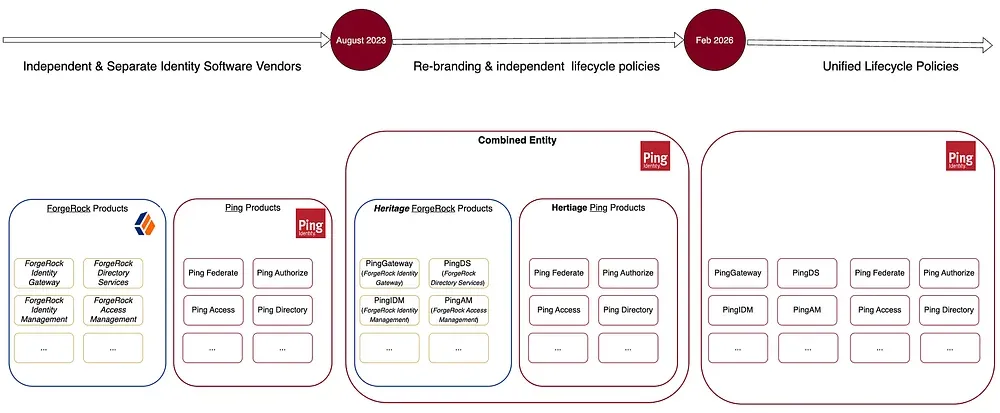
Figure 1: Ping Identity and ForgeRock — names and lifecycle-support evolution.
Versioning scheme
Ping Identity products use semantic versioning. A version contains three dot-separated components:
Major.Minor.Maintenance
For example, the PingAM version 8.0.1 consists of:
- Major: 8
- Minor: 0
- Maintenance: 1
For a separate explanation of software-version numbering, see Explanation of software version numbers.
Software product lifecycle stages
Ping Identity uses the following lifecycle designations:
- Generally Available (GA) — The product is available for purchase. The product release date is generally called the GA date.
- Active Maintenance — The product is actively developed, maintained, and supported.
- End of Maintenance (EOM) — Product maintenance has stopped, but customers may still receive support. Customers can submit support cases and obtain technical assistance under Ping’s support policy.
- End of Support (EOS) — The product is no longer maintained or supported.
- End of Life (EOL) — The product is obsolete and receives no maintenance, support, updates, or extended support.
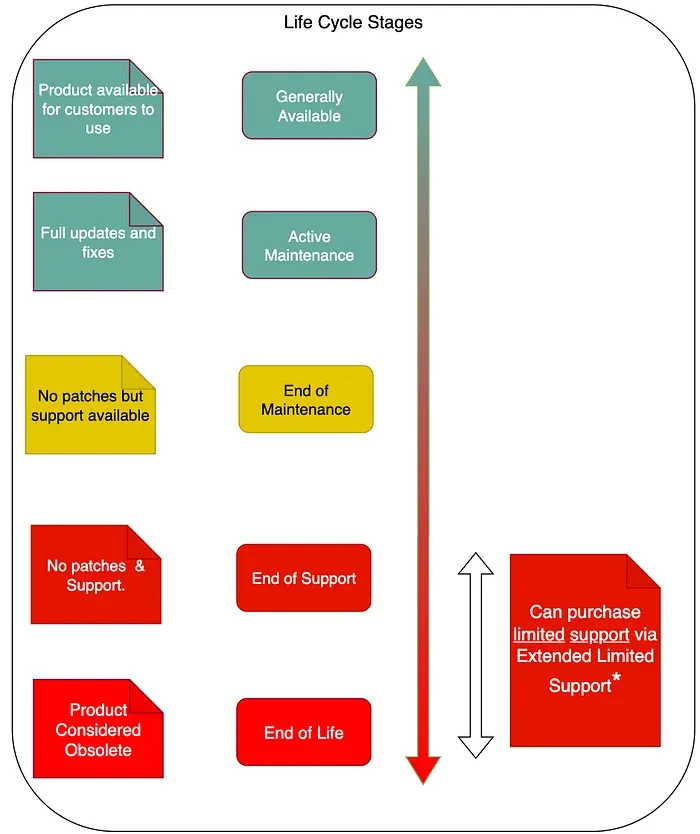
Figure 2: Key lifecycle stages.
Different software vendors may use different names for comparable lifecycle events. Check each vendor’s official definitions when assessing a product’s support status.
Customers may purchase Extended Limited Support (ELS) for an additional charge after a product reaches EOS. ELS is available only for specifically designated versions, so eligibility is not universal.
Avoid operating products that are unsupported or have reached EOL. Regulated sectors, including financial services, may restrict the use of such software. For example, the UK Prudential Regulation Authority and Australia’s Australian Prudential Regulation Authority (APRA) provide guidance relevant to the use of unsupported software.
Current state lifecycle: from August 2023 through February 2026
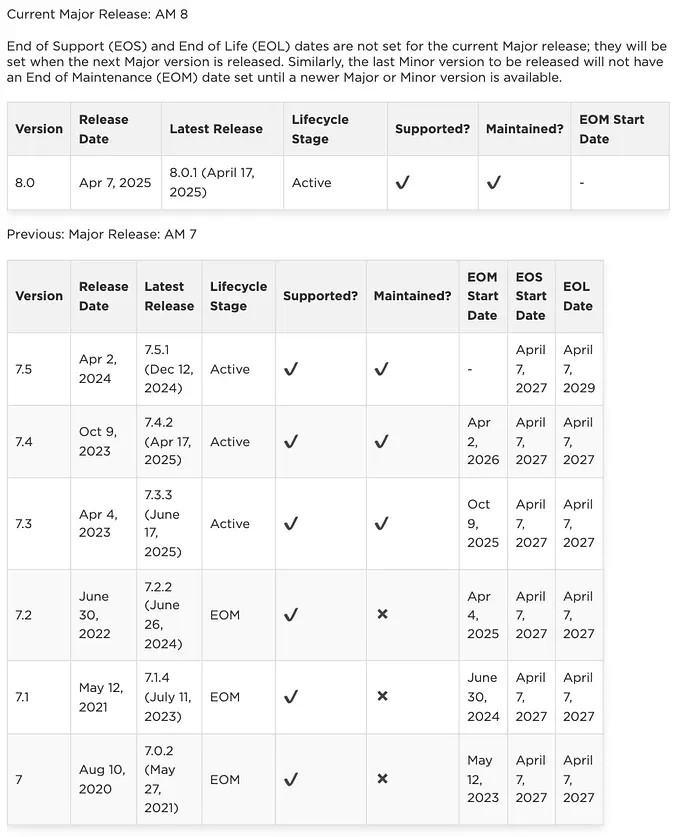
Table 1: PingAM lifecycle-stage dates, based on the heritage ForgeRock support policy.
The table presents lifecycle dates for PingAM versions 7 and 8 under the earlier support arrangement. The key points are:
- Versions 7.0, 7.1, 7.2, and 7.3 have passed EOM but remain eligible for support.
- EOS, EOL, and EOM calculations use the major and minor version numbers.
- PingAM 7.5, the final minor version in the previous major series, does not yet have an EOM date.
Future state lifecycle and support: beyond February 2026
Beginning in February 2026, Ping Identity will designate product versions as either Long Term Support (LTS) or Short Term Support (STS).
LTS releases are intended for critical deployments that prioritize operational consistency and longer security coverage. Banks and insurance companies are examples of organizations likely to favor this model.
STS releases are intended for environments where obtaining new capabilities quickly is more important than having the longest support window.
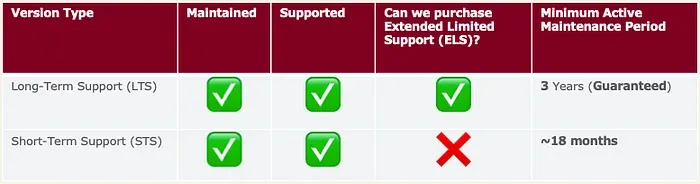
Table 2: Comparison of LTS and STS versions.
Ping Identity expects, but does not guarantee, to introduce new LTS versions approximately every two years.
The revised framework is intended to provide both LTS and STS support paths, with more predictable maintenance and upgrade planning.
Illustrative PingAM release sequence
The following hypothetical releases demonstrate how the lifecycle model could operate:
- AM 10 — STS: March 2026
- AM 10.1 — STS: May 2027
- AM 10.2 — LTS: November 2027
- AM 11 — STS: February 2028
- AM 11.1 — STS: May 2028
- AM 11.2 — LTS: August 2028
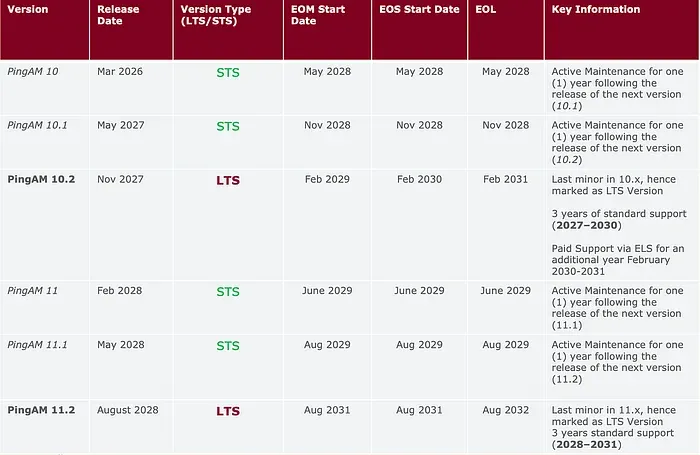
Table 3: Illustrative lifecycle dates for a future PingAM release under the unified support policy.
Summary view of key benefits for enterprises
The unified policy is expected to provide four benefits for enterprises:
- Stability: LTS releases provide three years of guaranteed support.
- Predictability: A regular release pattern, with LTS versions expected roughly every two years, supports upgrade planning.
- Flexibility: LTS versions may receive an optional additional year of ELS.
- Simplicity: Heritage Ping and heritage ForgeRock products will follow one unified policy.
From self-hosted to SaaS: are lifecycle stages and support still relevant, or just a legacy concern?
Many organizations are adopting software as a service (SaaS) and other hosted services.
Ping Identity offers three cloud options:
- PingOne Advanced Services: Single-tenant services.
- PingOne Advanced Identity Cloud: Single-tenant services.
- PingOne Cloud Platform: Multi-tenant services.
With these hosted offerings, customers do not generally manage product versions or lifecycle milestones themselves. Ping Identity manages platform updates, patches, and support, reducing the customer’s need to plan around individual software EOL dates.
Frequently asked questions
Can STS versions be used in production?
Yes. Both STS and LTS releases are production-capable. The difference is that STS versions have shorter support periods, requiring customers to plan upgrades more frequently.
Do STS and LTS versions receive patches in the same way?
Both release types receive regular patches. However, Ping Identity may schedule the patches differently for STS and LTS versions.
Is there a fixed STS release schedule comparable to the approximate two-year LTS cadence?
No fixed STS timetable is specified. Each product family determines its STS timing according to its feature backlog and customer requirements.
The stated goal is to provide at least one STS release per product each year, although some product families may publish more than one.
Does the new model extend the release approach already used by PingGateway?
Yes. PingGateway has used a similar LTS/STS-style approach since 2023, although it did not formally use those labels.
The 2025.3, 2025.6, and 2025.9 releases are STS examples, and the forthcoming 2025.11 release is an LTS version. From February 2026, all Ping products are expected to use the LTS and STS framework.
Under the new approach, the final minor release within each major release becomes the LTS version, following the practice PingGateway has used for its three-year support model.
Is there a current-version mapping for STS and LTS releases?
Yes. See Ping Identity’s End of Life Tracker.
Active versions designated as LTS or STS are covered by the unified policy. The example shown identifies PingAM 7.5 as LTS and PingAM 8.0 as STS. Other versions, including PingAM 7.4 and 7.3, continue under their existing maintenance and support policies.
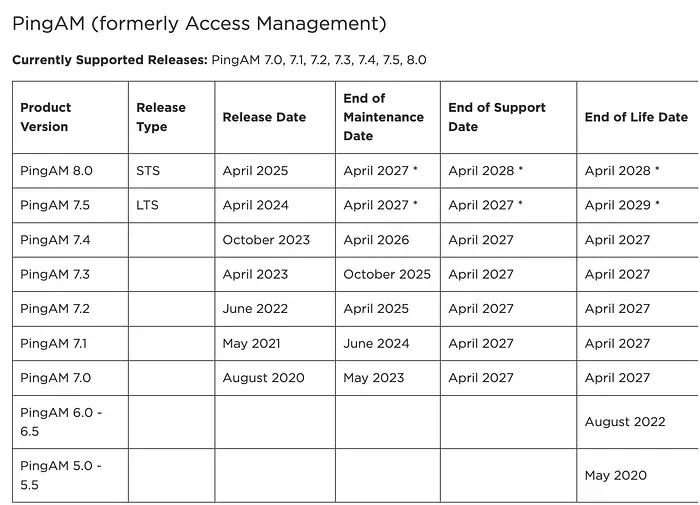
Table 4: Active PingAM versions designated as STS and LTS.
Are whole major versions assigned as LTS or STS, as in the Java release model?
No. Ping Identity does not designate an entire major version as LTS or STS.
Instead, the last minor release within each major version is the LTS release. Earlier minor releases in that same major series are STS. Consequently, each major release is expected to contain one LTS version and one or more STS versions.
Conclusion
Ping Identity is consolidating the lifecycle arrangements for its heritage Ping and ForgeRock products into a unified framework containing both LTS and STS release types.
LTS releases are intended to provide a three-year guaranteed maintenance period, helping organizations operate critical systems with greater stability and plan future upgrades more consistently.
Acknowledgements
The article thanks Jessica Chow, Matthew Berzinski, and Marc Harris for reviewing the article and providing suggestions.
References
- ForgeRock product renaming information
- Unified End of Life Policy, effective February 1, 2026
- Explanation of Apple and software-industry version numbers
- Semantic Versioning specification
- PingOne documentation
- PingOne Advanced Identity Cloud documentation
- PingOne Advanced Services documentation
- PingOne Advanced Services and PingOne Cloud Platform comparison
- PingGateway release timeline
- Ping Identity EOL Software Tracker
- Ping Identity Support Policy
Do you have thoughts or questions on this article? Join the discussion on the Ping Identity developer community.